What is an Opportunity Solution Tree?
The Opportunity Solution Tree (OST) is a visual framework that helps product teams chart the best path to their desired outcome. Created by Teresa Torres, it's become the go-to tool for teams practicing continuous discovery.
Understanding the Four Layers
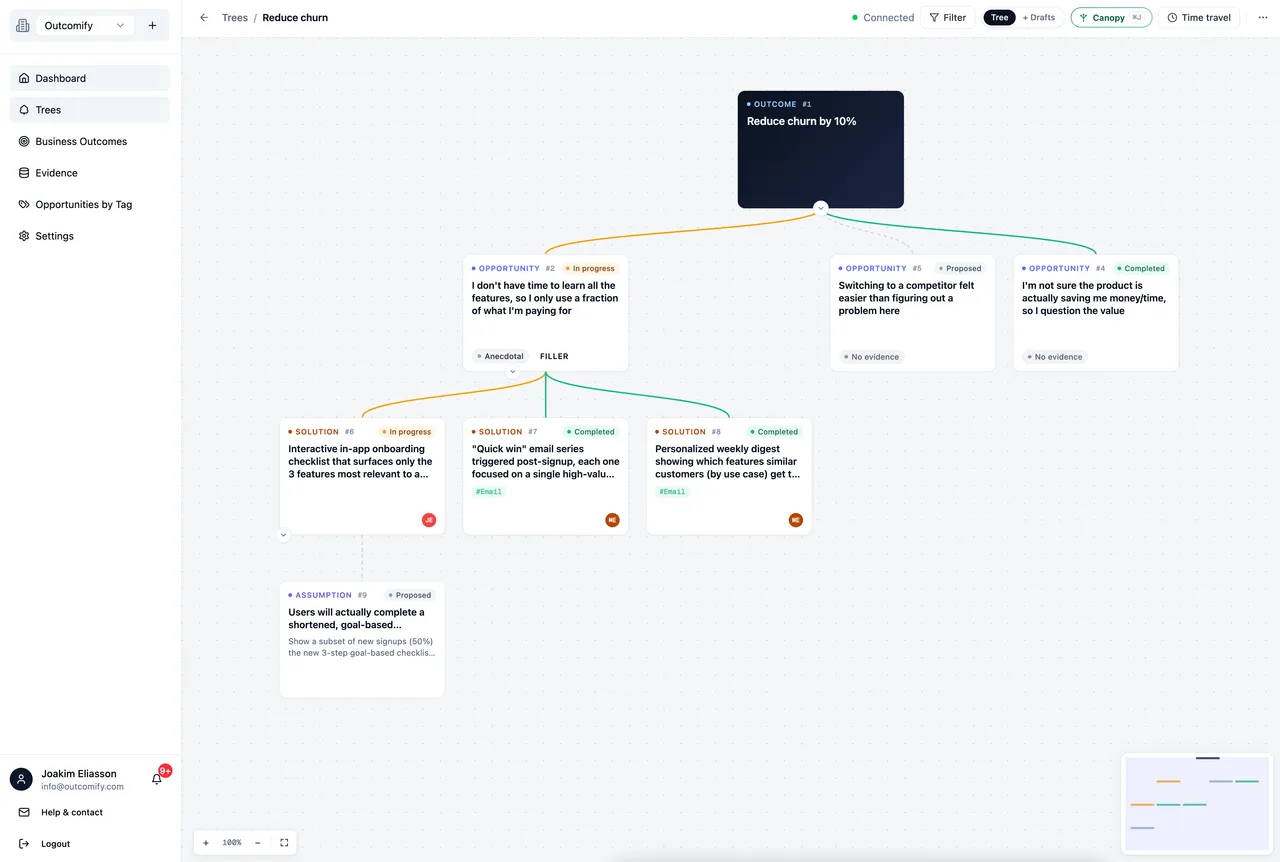
Read the tree above from the top down — a measurable outcome, the customer opportunities that could move it, solutions worth trying, and the assumptions each one is betting on. Here's what each layer is for, following that same branch.
One measurable result at the root — a change in customer behaviour you can actually move, not a revenue number you can only hope for. Keep it to one outcome per tree so the team stays focused.
Examples:
- •Reduce churn by 10%
- •Increase activation to 60%
- •Grow weekly active teams by 20%
A customer need or pain that, if you addressed it, would move the outcome. Phrase it in the customer's own words and pull it from interviews — not a brainstorm. The first example below is a real churn driver, quoted from a user.
Examples:
- •I don't have time to learn the features, so I use a fraction of what I pay for
- •I can't tell which teammates are active
- •Setting this up feels like a second job
Something you could build to address the opportunity. Sketch two or three per opportunity — a branch with a single solution usually means you married your first idea.
Examples:
- •Interactive in-app onboarding checklist
- •A weekly "quick win" email
- •Guided setup based on their goal
What has to be true for a solution to work — that customers want it, can use it, and that it actually moves the metric. Test the riskiest one (high stakes, little evidence) before you build, not after.
Examples:
- •Users will finish a shortened, goal-based checklist
- •Finishing it raises adoption, not just clicks
- •The digest survives the spam folder
Benefits of Using an OST
Opportunity Solution Trees help product trios work more effectively together.
Every feature can answer "why?"
A solution only exists under an opportunity, which only exists under an outcome. When a request can't trace up to a real customer problem and a metric you're moving, the tree makes that impossible to hide.
Disagreements get specific
"I don't like the roadmap" is a dead end. "I don't think that's the biggest opportunity on churn" is a conversation. The tree turns strategy arguments into one pointable question: is it the outcome, the opportunity, or the solution we see differently?
You stop marrying your first idea
Because solutions sit side by side under an opportunity, a branch with only one solution stands out as under-explored — a quiet nudge to find alternatives before you spend engineering time.
Research finally has a home
Opportunities come from interviews, and evidence attaches to them. Insights stop dying in a doc nobody reopens and start shaping what gets built next.
The thinking outlives the sprint
Outputs ship and are forgotten. An OST is a standing model of what you believe about your customers — a new teammate can read a quarter of discovery in five minutes instead of spelunking through tickets.
You can say no with a reason
When a pet feature maps to no opportunity under your outcome, declining it stops being political and becomes a decision you can point at.
How do you build one?
The short version: put a measurable outcome at the root, map the opportunity space from real customer interviews, then pick one target opportunity instead of boiling the ocean. Sketch two or three competing solutions for it, and test the riskiest assumption under your favourite before you build. Do that once and you have a diagram; do it every week as you learn and it becomes how the team decides what to work on.
Who Should Use an OST?
Opportunity Solution Trees are designed for product trios - a product manager, designer, and engineer working together. The visual nature helps the whole team align on what to build and why.
OSTs are especially valuable for teams practicing continuous discovery - regularly interviewing customers, testing assumptions, and iterating on their product strategy.
Frequently Asked Questions
Common questions about Opportunity Solution Trees
Keep exploring
OST Software
What to look for in a tool built for Opportunity Solution Trees.
Opportunity Discovery Workshop
Run a workshop to map the opportunities your tree hangs off.
Outcomes vs Outputs
Why outcomes beat outputs — the mindset an OST is built on.
Miro Alternative for OSTs
Why a purpose-built tool beats a whiteboard for OSTs.
The Opportunity Solution Tree was created by Teresa Torres and introduced in her book Continuous Discovery Habits. Outcomify is an independent product built to support that framework, and is not affiliated with, sponsored by, or endorsed by Teresa Torres or Product Talk.
Ready to build your first OST?
Outcomify is the purpose-built tool for Opportunity Solution Trees. Start your free trial today.