Free tool · no sign-up

LTV:CAC calculator

Four numbers tell you whether growth pays: what a customer brings in, your margin, your churn and what a customer costs to win. Get lifetime value, what each customer is worth after their acquisition cost, the LTV:CAC ratio and how long CAC takes to earn back.

Your revenue, margin, churn and CAC

$/ month
%

Revenue left after hosting, support and other costs of serving a customer. SaaS is often 70–85%.

%
$

Sales and marketing spend ÷ new customers won, over the same period.

Currency
Customer lifetime value (LTV)
$2,640
Gross margin over an average 33.3-month life (1 ÷ churn).
Net value per customer
$1,740
Lifetime value minus the $900 it costs to win them.
LTV:CAC
2.9 : 1
Below 3:1. Each customer pays back, but thinly.
CAC payback
11.4 mo
Within a year: healthy.

Payback, month by month

Earning back the $900 CAC: 11.4 months Profit: 22 months, $1,740

The formulas

  • Monthly margin per customer = revenue per customer × gross margin
  • Average lifetime = 1 ÷ monthly churn (in months)
  • LTV = monthly margin × average lifetime
  • Net value per customer = LTV − CAC
  • LTV:CAC = LTV ÷ CAC
  • CAC payback = CAC ÷ monthly margin (in months)

Benchmarks

Investors and operators usually look for an LTV:CAC of at least 3:1 and a CAC payback under 12 months. Treat them as rules of thumb: a business with fast payback can grow on its own cash even at a lower ratio, while a high ratio with a three-year payback still needs a lot of capital.

Where the number misleads

Simple LTV assumes churn is constant and revenue per customer never grows. Early churn is usually higher than late churn, and expansion revenue raises what loyal customers are worth, so cohort data beats this formula once you have it. Blended CAC also hides channels: a 3:1 average can be a 6:1 channel subsidising a 1:1 one.
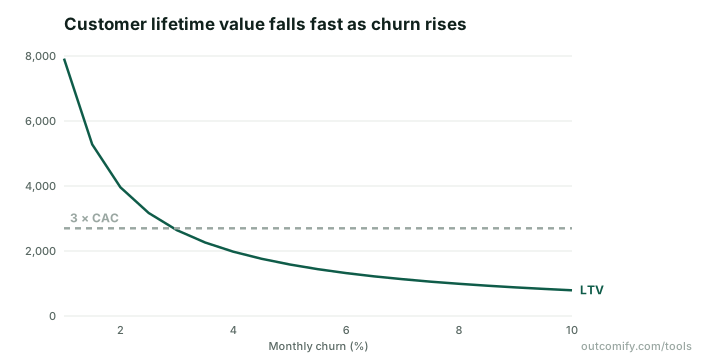
Line chart of customer lifetime value against monthly churn for a customer paying 99 a month at 80% gross margin: LTV falls from about 7,900 at 1% churn to about 790 at 10%.
Lifetime value is margin ÷ churn, so it falls steeply as churn rises: here 99 a month at 80% margin, against a CAC of 900.

Free in Outcomify

Find where new customers drop off before they pay

The cheapest way to improve LTV:CAC is to convert more of the sign-ups you already paid for. Outcomify’s free key funnels show each step from sign-up to paid, and whether what you shipped moved it.

Frequently asked questions

For a subscription business: LTV = average monthly revenue per customer × gross margin ÷ monthly churn rate. A customer paying 100 a month at an 80% margin and 2% monthly churn is worth 100 × 0.8 ÷ 0.02 = 4,000 in gross margin over their life.

The common benchmark is 3:1: a customer brings in three times what it cost to win them. Below 1:1 you lose money on every customer. Well above 5:1 often means you could spend more on growth and still be profitable.

What a customer leaves once you have paid to win them: lifetime value minus customer acquisition cost. A customer worth 2,640 in gross margin who cost 900 to acquire is worth 1,740 net. LTV:CAC says how many times over a customer pays back; net value says how much that is, which is what you can spend on growth or keep.

The months it takes a customer’s gross margin to pay back what you spent to acquire them: CAC ÷ (monthly revenue per customer × gross margin). Under 12 months is considered healthy for most SaaS; enterprise businesses often accept 18–24.

Revenue overstates what a customer is worth: hosting, support and payment fees come out of it before anything is left to pay back acquisition. Using gross margin makes LTV comparable with CAC.

Average lifetime is 1 ÷ churn, so halving churn doubles how long a customer stays and doubles LTV. Going from 5% to 2.5% monthly churn takes the average lifetime from 20 months to 40.

No. Everything runs in your browser and your numbers stay in the page address, so a copied link shares the same scenario. Nothing is sent anywhere.