Free tool · no sign-up
RICE score calculator
List your ideas, rate each one’s reach, impact, confidence and effort, and see them ranked. Share the list with a link or download it as a CSV.
Your ideas to score
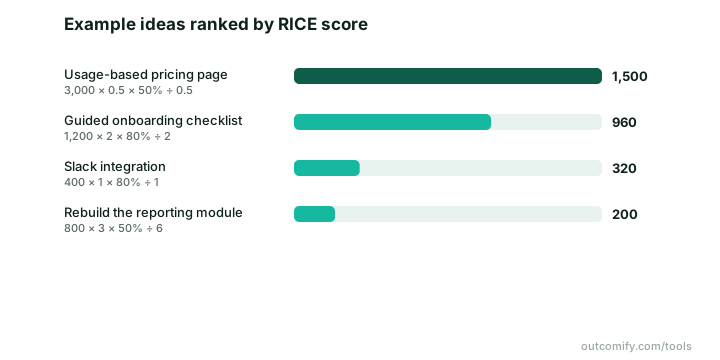
Ranked by RICE score
- 1Usage-based pricing page1,500
- 2Guided onboarding checklist960
- 3Slack integration320
- 4Rebuild the reporting module200
The four factors
- Reach: people or events affected per period, as a real number.
- Impact: how much it moves each person, on Intercom’s scale: 3 massive, 2 high, 1 medium, 0.5 low, 0.25 minimal.
- Confidence: how sure you are about reach and impact: 100% with data, 80% with some evidence, 50% on a hunch.
- Effort: person-months across product, design and engineering.
Make confidence honest
Confidence is the factor most worth arguing about. If an idea’s impact rests on a guess, give it 50% and go find evidence: a few customer interviews or a quick test can lift it to 80% or drop it off the list. That is cheaper than building the wrong thing.
Start from the problem
RICE compares solutions. Before scoring, check that every idea serves the same outcome and a customer need you have actually heard. Ideas that serve no known need don’t deserve a score yet.
Free in Outcomify
Know what customers ask for before you score it
Reach and confidence are guesses until customers tell you. A free Outcomify feedback board collects their requests and votes, and shows the need behind each one, so your RICE inputs come from evidence.